

The Steampunk Satyricon

Thursday, March 13, 2025
Happy Pi Day!
3.14159265358979323846264338327950288419716939937510582097494459230781640628620899862803482534211706798214808651328230664709384460955058223172535940812848111745028410270193852110555964462294895493038196442881097566593344612847564823378678316527120190914564856692346034861045432664821339360726024914127372458700660631558817488152092096282925409171536436789259036001133053054882046652138414695194151160943305727036575959195309218611738193261179310511854807446237996274956735188575272489122793818301194912983367336244065664308602139494639522473719070217986094370277053921717629317675238467481846766940513200056812714526356082778577134275778960917363717872146844090122495343014654958537105079227968925892354201995611212902196086403441815981362977477130996051870721134999999837297804995105973173281609631... etc., etc., etc.


Wednesday, March 12, 2025


Monday, July 3, 2017
What's So Funny?

"Humor can be dissected as a frog can, but the thing dies in the process and the innards are discouraging to any but the pure scientific mind." — E. B. White
"They" always say if you have to explain a joke, it stops being funny. But "they" are probably assuming that no one ever tells jokes involving the graphs of trigonometric functions. Knowing the deeper meaning of a joke can be a fine thing, especially when it means learning a little bit of math or science along the way. Thus my new semi-, sort-of-, perhaps-regular feature: "The Big Bang Theory Exposed & Explained."
You do watch "The Big Bang Theory," don't you? You're not one of those dirtbag snobby little bitches who proudly declares they don't watch TV, are you? The show debuted in 2008 and, if you do own a television, the syndicated reruns are fairly ubiquitous. "The Big Bang Theory" (TBBT) delivers tiny morsels of science to the masses with a cupful of sugar to help the medicine go down. I'm pretty sure there are people who have only ever heard the phrase "algebraic topology" because one of the characters used the term on an episode of the show.
Like most sitcoms, TBBT is really just another show about relationships, not science. But in this case, since most of the main characters' primary relationship is with science (factual science and science fictional science), quite a few of the show's jokes have touched on important scientific principles — anything from higher mathematics to particle physics to Newtonian mechanics and beyond.
Anyone can watch and enjoy the show, but there is so much more to appreciate if you can understand some of the science that gets talked about. Rather than leaving explanations to some lengthy, opaque, possibly wrong, definitely dry and shirtless-actor-free Wikipedia entry, I feel it's worthwhile to present a slightly more relevant and accessible explanation of that thing some character mentioned that you're afraid to admit went clean over your head. (Your secret is safe.)
So, all that having been said, let us begin the dissection...
Wednesday, January 1, 2014
Fried

It's a very familiar scenario to those of us who haven't given up on greasy, spectacularly unhealthy fast foods: You step up to the counter of your preferred burger joint and, thinking only of how extremely hungry you are, you order the large fries. You are given a disturbingly huge mound of french fries that any normal human would be extremely unwise to consume at one sitting, so you either throw out the leftovers or -- since throwing away food is wrong because of all the starving children in Africa/China/India -- you take the uneaten fries home so you can stick them in the fridge... and throw them away at a more convenient time. The fries are inevitably destined for the trash because, as everyone knows, cold, leftover fast food french fries taste like rubber. This raises the question: Is there another way this scenario might play out?
You could just stop buying french fries because they're nothing but empty, fat-laden, delicious calories that won't get burned off because your exercise routine is pretty much just a figment of your imagination... but who are we kidding? What's really needed is a strategy for rescuing those cold, dead fries and making them tasty again. The first thing a fry-rejuvenator might be tempted to try is simply sticking them in the microwave for a few seconds, but if you know anything about frying, you'll already know why such a plan is destined to yield less than appetizing results.
There is, in fact, a huge amount one might know about frying. Humans, starting with the Chinese, have been deep-fat frying for the last 3,600 years or so and we still don't know all there is to know about the process. When raw potatoes hit sufficiently hot oil, so much goes on at the molecular level that one could easily spend an entire semester of college studying the subject. Let's see what I can do in about a thousand words...
Wednesday, December 11, 2013
The Commercial Imperative
New Science Kick stuff at Cafe Press. One that sums up the philosophy behind this blog...

As much as I try to take an even-handed approach to politics here, allow me to officially come clean about my personal political leanings (in the name of capitalism, natch)...

As much as I try to take an even-handed approach to politics here, allow me to officially come clean about my personal political leanings (in the name of capitalism, natch)...
Tuesday, January 1, 2013
What Did Chu Do?
 |
| Second Life avatar that is definitely not Dr. Steven Chu |
There are idiots in this world who are actually more impressed by a Super Bowl ring than a Nobel Prize in physics. Fortunately, when the White House needed to appoint a Secretary of Energy in 2009, staffers tossed aside the résumés of grossly under-qualified NFL quarterbacks and selected Dr. Steven Chu, Director of the Lawrence Berkeley National Lab. Chu received a Nobel Prize for his work in 1997... but what exactly did he do to get it? What did Chu do?

First off, it should be noted that what he did, he didn't do alone. Chu shared the prize with two other physicists -- William D. Phillips of the National Institute of Standards and Technology (NIST) in Gaithersburg, Maryland and Claude Cohen-Tannoudji of l'École Normale Supérieure in Paris -- and all of them were no doubt assisted by a small army of physics graduate students and postdocs. Science is rarely a solitary endeavor these days.
Chu and company were recognized for perfecting a process called "laser cooling." Most people hear the word "laser" and immediately think of heat rays burning or melting or slicing through things... or just projecting little red dots onto PowerPoint™ presentations. On a human scale, lasers that have been configured a certain way can do those things. On the subatomic scale, a laser beam is just photons, little particles of light with a few distinguishing, but very important, characteristics. Including the ability to make things cold.
Wednesday, May 16, 2012
Full Contact Chemistry

Please consider, for a moment, the 1999 Twentieth Century Fox movie "Fight Club." You know that movie, don't you? Edward Norton as the unnamed narrator? Brad Pitt as the seductive subversive, Tyler Durden? Helena Bonham Carter playing a deliciously deviant psycho chick? Lots of sweaty men beating the crap out of each other? Homemade explosives for fun and mayhem? If you've never seen it, I strongly advise watching it.

I would draw your attention to a particular scene that begins approximately 61 minutes and 11 seconds into the movie where, in the rundown kitchen of a rundown house on a rundown street the characters played by Norton and Pitt are making soap. The scene starts with a history lesson and ends with a patch of burnt flesh.
"This is Lye."

Lye, also known as sodium hydroxide or caustic soda, is typically sold as a powder and can be purchased in many hardware stores or online without much fuss. Each sodium hydroxide molecule is made up of one sodium atom (Na), one oxygen atom (O) and one hydrogen atom (H), written by chemists as NaOH. In solution, lye is highly alkaline meaning it has a very high pH (percent hydrogen) value.
Higher pH, between 7 and 14 = alkaline like baking soda
Lower pH, between 1 and 7 = acidic like vinegar
pH of 7 = neutral like water or human blood
Concentrated sodium hydroxide is one of the most powerfully alkaline chemicals you'll ever encounter. An alkaline solution is also known as a "base" which is the opposite of an acid. Remember acids and bases from science class? ("Oh boy! Lemon juice turns blue litmus paper red! Look at that! Ammonia turns red litmus paper blue! My god, this is so lame!!") A refresher on acids and bases later, but for now, back to soap...
The fancy word for the chemical process that produces soap is saponification. You get things started by performing the somewhat hazardous task of mixing a lye solution and then boiling it along with some kind of fat -- be it whale blubber, olive oil, cocoa butter, or (as in "Fight Club") the creamy, bloody flab that's been liposuctioned out of vain rich people. Unwanted byproducts are scooped away and the hot mess is then allowed to cool producing glycerin and a no-frills kind of soap that's solid or liquid depending on the concentrations of the ingredients you added.
And now...
Wednesday, February 1, 2012
The Dismal Science of Deflation
I kept hearing conservatives certain people complain about the Federal Reserve for "printing money" and I began to wonder exactly what they were so upset about. Here's the deliberately over-simplified explanation I've been able to piece together:
People like me tend to think of inflation as "stuff getting more expensive." But another way to think of it is "non-cash assets becoming more valuable." This is why a little inflation happening can be good -- it's some of the stuff you own increasing in value before your very eyes.
(How's this for inflation: Of the almost 900 paintings created by Vincent Van Gogh, he only sold one during his lifetime, "The Red Vineyard" in 1890, for the modern equivalent of about $1,600. A conservative estimate of the painting's current value is somewhere between the gross national product of Anguilla and "OH MY FUCKING GOD!!!")
An increase in the value of your leveragable assets means you can borrow lots of money against your now-more-valuable stuff -- money which you will use to increase your wealth by investing it or using it to grow a business. A little inflation is seen by some as good. A lot of inflation is seen by everyone as bad. But what some people see as truly horrible is even a hint of the dreaded deflation.
People like me tend to think of inflation as "stuff getting more expensive." But another way to think of it is "non-cash assets becoming more valuable." This is why a little inflation happening can be good -- it's some of the stuff you own increasing in value before your very eyes.
(How's this for inflation: Of the almost 900 paintings created by Vincent Van Gogh, he only sold one during his lifetime, "The Red Vineyard" in 1890, for the modern equivalent of about $1,600. A conservative estimate of the painting's current value is somewhere between the gross national product of Anguilla and "OH MY FUCKING GOD!!!")
An increase in the value of your leveragable assets means you can borrow lots of money against your now-more-valuable stuff -- money which you will use to increase your wealth by investing it or using it to grow a business. A little inflation is seen by some as good. A lot of inflation is seen by everyone as bad. But what some people see as truly horrible is even a hint of the dreaded deflation.
Monday, September 12, 2011
Mathematics: Gateway to the Merry Land of Science... So deal with your math anxiety and quit being such a big, damn wuss about it, you effing coward!!!
 |
| Photo: From Colby Keller's Big Shoe Diaries blog. Submitted as part of the Fearless photo project. |
If you want to know what the takeaway is for this piece on math anxiety, you don't even have to read past this opening paragraph, I'll give it to you up front: "Fashionable innumeracy" -- the idea that it's perfectly acceptable to be a mathematical moron -- ends here. Right now. From this moment forward, it is no longer okay to say you're bad at math. It's totally fine if you're not a genius, just quit acting like a math-shy half-wit. If you're faced with a math problem on the job, or in any situation, you can say, "Math is a little tricky for me," or, "I'll need a little help with this," or, even better, "I've got to work on my math." But fleeing in terror and declaring, "I'm bad at math!" while expecting to be given a sympathetic pass for your cowardice ends now. I mean it! Continue to shamelessly avoid math and you will be stripped of your citizenship and deported. Maybe not today, but it's something I'm working on. Seriously. I've written letters.
If you'd like to stall a bit before finally facing your fears, do feel free to read on...

Somewhere in America, there's a hairy, leather-clad biker dude who spends his days dealing drugs and doing math. That's "math" not "meth" -- although he might be doing that as well. Throughout his workday, he's probably doing arithmetic, fractions, even some simple algebra. He's probably even calculating odds in his head using basic statistics. And yet, for however long he was in school before he dropped out, he was probably one of those students who said, "Why I gotta study this [EXPLETIVE]? I ain't never gonna use this [EXPLETIVE]!" It's a classic dodge employed by people who claim they'd rather not "waste" time studying math. The truth, of course, is that math scares the [EXPLETIVE] out of them.
Math anxiety is real, but it isn't the same as test anxiety and it must also be distinguished from other more general anxiety disorders. Math anxiety is almost like a straight-up case of failure anxiety, but not quite... and, honestly, you probably don't have it. At least, not a serious case of it. Put a timed math test in front of some people and they'll get the shakes, the sweats, cry a little, then vomit. For most people, it simply isn't that bad, but the flood of feelings math anxiety induces is unique and unmistakable. It's that moment in class when the word problems, the geometric proofs and the almost unbearable pressure that comes with trying to solve for "x" make you feel as if you've just been dropped into a foreign country where you can't read or speak the language and you really, really need to find a bathroom. Or, as Sheila Tobias says in Overcoming Math Anxiety, "The first thing people remember about failing at math is that it felt like sudden death."
Tuesday, May 31, 2011
A Certain Book
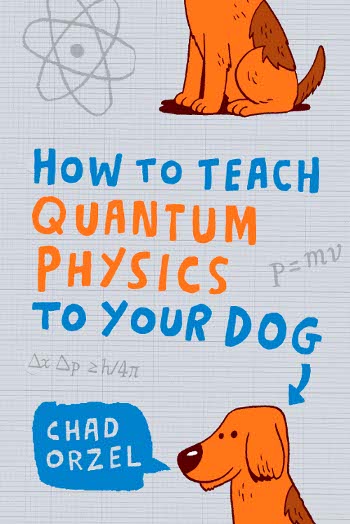
A little while ago, I noticed a book cover that had a major problem. The book was the UK edition of Dr. Chad Orzel's How to Teach Quantum Physics to Your Dog, which sports a couple of scientific formulas on its cover... and one of them didn't look right.
"Ah-Ha!" I said in an accusatory manner to the imaginary publisher sitting in front of me. "Did you think your mistake would go unnoticed? Ghosting the equation back to a 30% gray has failed to mask your egregious error, you cretinous lackwit!"
But before transmitting a scathing missive to the real publisher like an annoying little know-it-all douche, I decided to check and make sure I was remembering things correctly. As a reflective, self-aware, highly insecure individual, I felt it was important to make sure *I* wasn't the one who was "Wrong, wrong, wrong!"
The equation in question was for the position-momentum form of the Heisenberg uncertainty principle. It's named after Werner Karl Heisenberg who developed the theory in the late 1920s/early 1930s. I've said it before and I'll say it again: When your peers are naming stuff after you, you know you're good. Heisenberg died in 1976 with a Nobel Prize on his shelf and a place in history for helping invent the field of quantum mechanics.
In retrospect, the uncertainty principle seems pretty obvious: Light is energy and we need light to see things, but at the subatomic level, you can't shine a light on something without giving it energy thus changing the nature of the subatomic thing you're trying to look at. One way of expressing this idea is with the equation "delta-x times delta-p greater-than-or-equal-to h divided by two pi", or

This equation describes what we think is probably happening to some subatomic particle we're interested in. Delta-x and Delta-p can be thought of as measures of probability. Delta-x represents how sure we are a particle is in a certain position. Delta-p represents how sure we are about a particle's momentum. But momentum (p) is equal to mass (m) times velocity (v), typically written as p = mv. So, since the mass of the particle doesn't change, you can say that Δp is really a measure of how sure we are about a particle's velocity.
That "h" is Planck's constant, a number related to the energy and frequency with which a particle oscillates. It was discovered by Max Karl Ernst Ludwig Planck around 1900. (When people start naming stuff after you...) In the uncertainty equation,
h = 6.626 x 10⁻³⁴ J•s
The units for Planck's constant are "Joule-seconds" (sometimes I will willingly stress over detailed explanations of what the units mean, but not today). The quantity [h/(2π)] turns up so often in physics that it was given a special symbol (called h-bar) which is why you sometimes see the uncertainty relation written as

In Germany, there was even a Heisenberg stamp with the equation on it, fer chrissakes! So that's what I thought the uncertainty equation was, meaning the equation I saw on the book cover was wrong. Except it wasn't.
Thursday, May 5, 2011
Placenta is Awesome!
I'd heard the terms "placenta" and "afterbirth" tossed around, but when they show a baby being born on television, usually the most you ever see is part of the umbilical chord and no one ever seems to talk specifically about the placenta. And since I have no interest in being a father or getting anyone pregnant, learning more hasn't exactly been on my "To Do" list. But I'm here t' tell ya:

Placenta is awesome!
Do you have any idea how *awesome* placenta is?? Why does no one ever talk about how awesome placenta is? Is it one of those things where men who aren't doctors dismiss it as unimportant because they don't have to deal with it directly? Or maybe it's because placentas look like bloody, disgusting raw liver when they come out a few minutes after the baby. Or maybe it's kind of like the Opening Act Syndrome: people only care about the headliner (the baby) and are off buying t-shirts when the opener is on stage (in the case of the placenta, I guess it would be Closing Act Syndrome).
And, as I'm sure you've heard, there really are people who eat it. More on that later.
The placenta is formed by the trophoblast, a layer of tissue that surrounds the fertilized embryo and also forms the outer membrane that the baby sits in. Lots of proteins working at the molecular level interact to dig into mom's uterine wall and anchor the little parasite into place. Tiny tendrils called microvilli reach out like tree roots and hook the fetus into the mothers plumbing. But the placenta does way more than just hold the fetus in place. If pregnancy were a car, the baby would be in the passenger seat... the placenta would be the driver.
Friday, April 29, 2011
Calling Occupants of Interplanetary Craft

The Search for Extraterrestrial Intelligence could use a little help. Only checks drawn on Earth-based banks will be accepted.
http://www.seti.org

http://www.sciencefriday.com/program/archives/201104297

Friday, April 22, 2011
Fluid on the Brain
Some science demonstrations are such classics that it's hard to improve upon them. Which is why it's unfortunate that not every high school, or even every college, has the equipment on hand to allow students to see important scientific principles demonstrated in dramatic, vivid and memorable ways. At least we live in the age of YouTube and now everyone can see roses shattered after a quick freeze in liquid nitrogen, students spinning on swivel chairs to demonstrate the principle of angular momentum, electrodes separating water into hydrogen and oxygen gasses, and this classic demo of laminar vs. turbulent flow (courtesy of the mechanical engineering students at Georgia Tech)...
Which can only be followed up with a demonstration of metabolic activity and kinetic energy
Thursday, March 31, 2011
Filler Up!
No, no, no, no, no, no, no, no, no, no, no, no, no! It is UNACCEPTABLE to let an entire month pass without a blog post!! That will not happen!
But, since the *real* posts are still in the works, here is some filler:
First, the Heisenberg uncertainty principle presented as this go-round's gratuitous equation (more on this is forthcoming):

Next, a gratuitous science-related link that's both fascinating and icky. http://tinyurl.com/49g992b
Next, samples of the kind of gratuitous beefcake photos you will almost never see here:
And finally, back to the subject of uncertainty with an entirely-too-relevant quote from philosopher, mathematician and Nobel laureate Bertrand Russell (1872-1970):
But, since the *real* posts are still in the works, here is some filler:
First, the Heisenberg uncertainty principle presented as this go-round's gratuitous equation (more on this is forthcoming):

Next, a gratuitous science-related link that's both fascinating and icky. http://tinyurl.com/49g992b
Next, samples of the kind of gratuitous beefcake photos you will almost never see here:
No underwear-Speedo-jockstrap pics.
 |
| Always better to leave something to the imagination! |
No cell-phone-in-mirror pics.
 |
| Learn to use a camera with a timer! |
And finally, back to the subject of uncertainty with an entirely-too-relevant quote from philosopher, mathematician and Nobel laureate Bertrand Russell (1872-1970):
"The whole problem with the world is that fools and fanatics are always so certain of themselves, but wiser people so full of doubts."
Wednesday, February 16, 2011
Never Not Funny
You know how hilarity immediately ensues when, after enjoying a Chinese take-out meal, you crack open the fortune cookies, read the fortune and add the words "in bed" to whatever is on the little slip of paper? I've discovered a similar effect can be achieved simply by adding the words "The Musical!" to the end of the title of any scientific paper. Witness...


You see? You see?!? THAT IS NEVER NOT FUNNY!!!!
Not sure it works the other way, though...

- Vacuum stability and the Cholesky decomposition: The Musical!

- Analytical Study of Object Components for Distributed
and Ubiquitous Computing Environment: The Musical!

You see? You see?!? THAT IS NEVER NOT FUNNY!!!!
Not sure it works the other way, though...

Saturday, January 1, 2011
In with the New
Just some bits of business, links an' stuff...
But first, a gratuitous, scary-looking equation concerning the conductivity of graphene:


But first, a gratuitous, scary-looking equation concerning the conductivity of graphene:

- Don't forget the t-shirts!
- A print version of Science Kick is in the works. A 3MB preview PDF is available for download. http://www.capitaladsites.com/ScienceKick01.pdf

- Support citizen scientists! http://thecitizensciencequarterly.com/
- Support giant robots (and the guys who make them)! http://jamius.com/

- Consider Improbable Research! http://improbable.com/
Friday, December 31, 2010
Out with the Old
A catch-all, end-of-the-year megapost to clear the decks for the new year:
(10) Gratuitous display of one of the scary-looking equations that made cell phones possible.

An op-ed titled "Lab Politics" that appeared on the Slate web site a few weeks ago totally tweaked my outrage meter. The author -- Daniel Sarewitz, an academic at Arizona State University -- cited poll data that revealed 55 percent of scientists identified as Democrats and only 6 percent were Republicans (the rest were independent or undecided) and suggested that the American public would benefit if there were more scientists who considered themselves conservatives.
My initial reaction was, "Sarewitz, you're a whiny-ass moron." But the benefit of getting distracted and failing to write an immediate response is that you have a chance to reflect and give your reactionary fury a chance to subside. That's not to say there weren't major problems with the editorial.
Sarewitz starts with the completely faulty premise that *good* science is influenced by ideology. He openly accuses non-conservatives of doing bad science to score political points -- perhaps he was thinking of the pharmaceutical industry where "Science-on-Demand" is a regular occurrence and customized results, tailored to maximize profits, can end up killing people. Basically, Sarewitz is saying that scientists operate like political strategists (or pundits) who only ask questions when they already know what they want the answers to be. Science can be politicized, and when it is, it's no longer science -- it's bad science and we should all disregard it. But you can't dismiss good science just because you don't like what it tells you. There's a reason why no one takes flat-earthers seriously.
The real problem with Sarewitz's editorial -- like so many op-eds, where the writer is probably held to a word count even if it's for online publication -- is that the author states his grievance, but doesn't actually make a case. He raises the issue of climate change and suggests that if more climate researchers were Republicans/conservatives, more people would trust their findings. But Sarewitz only criticizes the policy suggestions for responding to the research findings, he doesn't explicitly mention any particular researcher or paper as being biased. He doesn't even attack the peer review process or give us proof that liberal reviewers are simply rubber-stamping work that conforms to their liberal views.
One woefully accurate aspect of the issue, that the author correctly alludes to, is that no debate can even begin if the two sides can't even agree on what the facts are. One side has its trusted sources and the other side has theirs. Both sides are convinced that their reality is the one that matters and the other side is presenting erroneous, hopelessly biased information that simply can not be considered credible. How is any kind of reasonable discussion possible where there is no common ground?
Sarewitz's op-ed is so wrong in so many ways that I'm tempted to go on for another 500 words, but there are other important (i.e. fairly trivial) things to get to. Suffice it to say that good scientists don't want to be leftists, they just want to be right.
Wednesday, November 3, 2010
Gobbledygook Pt. 1: Geophysics Without Fear
It was another object lesson in science's ability to obfuscate, intimidate and make you scratch your head till it bleeds. While I was researching the post before this one, I came across this passage in Geodynamics: Applications of Continuum Physics to Geological Problems:


Geophysicists, folks who might be looking for ore and petroleum and things underground, start with a standard measure of what gravity is like for the whole planet. But the earth doesn't have a uniform density, so the gravity is actually a little different depending on where on earth you are. This is why, in some places, you weigh a little less and in other places you weigh a little more (there can be other factors, but here we're concerned with the effects of density). The difference in how much you weigh in a particular location compared to the standard measure depends on the nature of the difference in the density of the earth where you happen to be standing. You can take measurements and calculate the difference because there is a mathematical relationship between how the earth's density at your location changes and how the gravity changes in that same place. Different things alter density in different ways, some of which are known. That's why knowing about gravitational potential anomalies is useful: measuring what the gravity is like at a particular location gives us a hint of what might be underground.
There, you see? Was that so hard? Don't we all feel better now?

Sources

"The gravitational potential anomaly [ΔU] due to a shallow, long wavelength isostatic density distribution is proportional to the dipole moment of the density distribution beneath the point of measurement."For the layperson, this is the very model of a "What the fuck????" gob of indecipherable science babble. Let's break it down [DON'T BE SCARED, IT'S ONLY SCIENCE]:

Gravitational potential -- If you pick up a brick, hold it above the ground, and then let it go, it won't just stay suspended in mid-air. By lifting it up, against the pull of gravity, you gave it a certain amount of stored energy, called potential energy. And since that energy -- which is equal to the energy the brick will have when it falls -- comes from doing work on the brick against the earth's gravitational pull (and don't forget, the brick is pulling on the earth too), we call that energy gravitational potential.

Gravitational potential anomaly -- General science tip: whenever you see a delta ("Δ") in an equation, that usually refers to some kind of change or difference between two things. "ΔU" represents the gravitational potential anomaly and refers to how different the measured gravitational potential is from a standard reference potential. The difference is due to the fact that the ground beneath us does not have a uniform density, so a reference potential is used to get an idea of how different the pull of gravity is at any given location.

Isostatic density distribution -- You can take two columns of earth, for example one that starts at the top of a mountain and one that starts on the ocean floor, and by the time you burrow down and reach the creamy filling (i.e. the big mass of molten lava that all land masses rest on) you'll have two columns of earth that weigh pretty much the same, but you'll find the mountain column will be less dense than the ocean floor column. The principle of isostatic density distribution tells us this will be true for any two columns of earth we might want to consider. The "long wavelength" part just means you're talking about something massive enough to make a dent in the lithosphere (which consists of the earth's crust and the top part of the mantle layer).

Dipole moment of the density distribution -- This one really threw me at first. I knew about dipole moments as they related to electric charges and magnetic fields, but didn't know what they had to do with rocks and dirt. If a gravitational anomaly is detected, that's an indicator the density of the earth in that area has sort of adjusted itself, compensated to achieve normal isostatic density distribution. Think of the dipole moment as a measure of the extent of the self-adjusting that occurred to get the right density distribution. Plus, it's proportional to the gravitational potential anomaly (as the equation at the beginning shows... trust me, that's what it says).
Moho -- Beneath the earth's crust, but before you get to the mantle layer, there is a boundary called the Mohorovičić discontinuity, or Moho for short. It was named after a Croatian seismologist and marks the depth at which there are notable changes in the earth's chemical composition compared to the crust above it. This has nothing to do with anything, I just like the word "Moho."So here's what the bizarre, scary passage at the beginning was saying:
Geophysicists, folks who might be looking for ore and petroleum and things underground, start with a standard measure of what gravity is like for the whole planet. But the earth doesn't have a uniform density, so the gravity is actually a little different depending on where on earth you are. This is why, in some places, you weigh a little less and in other places you weigh a little more (there can be other factors, but here we're concerned with the effects of density). The difference in how much you weigh in a particular location compared to the standard measure depends on the nature of the difference in the density of the earth where you happen to be standing. You can take measurements and calculate the difference because there is a mathematical relationship between how the earth's density at your location changes and how the gravity changes in that same place. Different things alter density in different ways, some of which are known. That's why knowing about gravitational potential anomalies is useful: measuring what the gravity is like at a particular location gives us a hint of what might be underground.
There, you see? Was that so hard? Don't we all feel better now?
Moho.
Sources
- Geodynamics: Applications of Continuum Physics to Geological Problems. ©1982, John Wiley & Sons, Inc.
- Geophysical Methods in Geology, 2nd Ed. P.V. Sharma. ©1986, Elsevier Science Publishing Co., Inc.
- U.S. Geological Survey, http://www.usgs.gov.
Wrong, Wrong, Wrong!
A certain incident has been nibbling away at my consciousness for ages like a kind of psychic termite. It happened in my freshman physics class when the teacher was introducing Newton's law of gravitation. In order to protect the reputation of said teacher, I shall refer to him here as Professor X.


Professor X presented the equation for finding the force exerted on an object by the earth's gravity. It's a classic, lovely little equation...
Me = the mass of the earth, about 1.3 x 1025 lbs or 5.97 x 1024 kilograms. (Do we remember our metric conversions and our scientific notation?)
m = the mass, in kilograms, of some object.
r = how far that object is from the center of the earth.
G = the universal gravitation constant, a sort of cosmic fudge factor, equal to
6.673 x 10⁻¹¹ N•m2/kg2
(the "N" stands for "Newtons", the unit of measure for force; read as "Newton meters squared per kilograms squared").
A student asked a question: "So, if r = 0, the force is infinite?"
Knowing that we had been taught in our math classes that anytime you divide a number by 0 the answer is ∞, Professor X said, "Yes, if r is 0, Fg is infinitely large."
There are a few reasons why the professor might have responded to the student's question with such an incredibly wrong answer:
Wednesday, September 22, 2010
WAY Faster Than A Speeding Bullet
There is an excellent article on the Washington Post's web site on Danish astronomer, Ole Romer, who devised a method of estimating the speed of light in 1676. The number he and his contemporaries got was about 30 percent slower than later findings, but getting even that close was fairly amazing given the equipment Romer and his colleagues had at the time. According to the article, even when it was recalculated later, "They didn't change Romer's method of calculation; they just had better data to feed into it." (The currently accepted value is 186,410 miles per second.)
 |
| Romer: Obsessed with speed. |
As interesting as the article was, I was particularly fascinated by the comment left by a reader who seemed to be lamenting the fact that the 700-word article didn't present a more thorough explanation of the calculations involved. I posted what I considered a fairly reasoned response. Of course, what I really wanted to say was, "Are you fuckin' kidding me?!? Pedantic, know-it-all assholes like you are *killing* interest in science! When will you people learn!!!" But that would have been so rude.
Also this week, new developments at the Large Hadron Collider as reported in The Guardian.
And also... FRACTALS!
Also this week, new developments at the Large Hadron Collider as reported in The Guardian.
And also... FRACTALS!
Subscribe to:
Posts (Atom)