

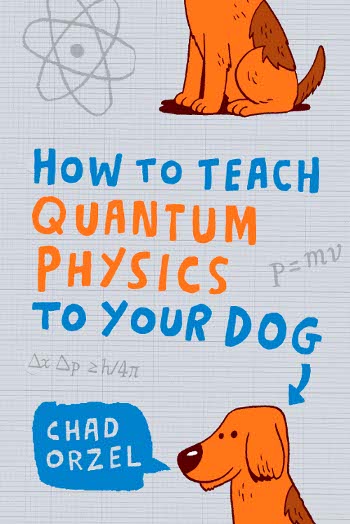
A little while ago, I noticed a book cover that had a major problem. The book was the UK edition of Dr. Chad Orzel's How to Teach Quantum Physics to Your Dog, which sports a couple of scientific formulas on its cover... and one of them didn't look right.
"Ah-Ha!" I said in an accusatory manner to the imaginary publisher sitting in front of me. "Did you think your mistake would go unnoticed? Ghosting the equation back to a 30% gray has failed to mask your egregious error, you cretinous lackwit!"
But before transmitting a scathing missive to the real publisher like an annoying little know-it-all douche, I decided to check and make sure I was remembering things correctly. As a reflective, self-aware, highly insecure individual, I felt it was important to make sure *I* wasn't the one who was "Wrong, wrong, wrong!"
The equation in question was for the position-momentum form of the Heisenberg uncertainty principle. It's named after Werner Karl Heisenberg who developed the theory in the late 1920s/early 1930s. I've said it before and I'll say it again: When your peers are naming stuff after you, you know you're good. Heisenberg died in 1976 with a Nobel Prize on his shelf and a place in history for helping invent the field of quantum mechanics.
In retrospect, the uncertainty principle seems pretty obvious: Light is energy and we need light to see things, but at the subatomic level, you can't shine a light on something without giving it energy thus changing the nature of the subatomic thing you're trying to look at. One way of expressing this idea is with the equation "delta-x times delta-p greater-than-or-equal-to h divided by two pi", or

This equation describes what we think is probably happening to some subatomic particle we're interested in. Delta-x and Delta-p can be thought of as measures of probability. Delta-x represents how sure we are a particle is in a certain position. Delta-p represents how sure we are about a particle's momentum. But momentum (p) is equal to mass (m) times velocity (v), typically written as p = mv. So, since the mass of the particle doesn't change, you can say that Δp is really a measure of how sure we are about a particle's velocity.
That "h" is Planck's constant, a number related to the energy and frequency with which a particle oscillates. It was discovered by Max Karl Ernst Ludwig Planck around 1900. (When people start naming stuff after you...) In the uncertainty equation,
h = 6.626 x 10⁻³⁴ J•s
The units for Planck's constant are "Joule-seconds" (sometimes I will willingly stress over detailed explanations of what the units mean, but not today). The quantity [h/(2π)] turns up so often in physics that it was given a special symbol (called h-bar) which is why you sometimes see the uncertainty relation written as

In Germany, there was even a Heisenberg stamp with the equation on it, fer chrissakes! So that's what I thought the uncertainty equation was, meaning the equation I saw on the book cover was wrong. Except it wasn't.

